Showing posts with label Movie Reviews. Show all posts

Wednesday, January 5, 2011

The Illusionist (L'Illusionniste)

French filmmaker Sylvain Chomet is in a category all his own in terms of filmmaking. Judging by the time between his projects (its been 7 years since The Triplets of Belleville), a conclusion could be reached that he is a perfectionist, with a delicate eye for detail. The Illustionist is only his second feature film, and while it has some hallmarks in common with Triplets, there is new territory here as well. Both films are nearly wordless and feature stylized characters in non-stylized settings. However, Triplets is a comedic adventure with bits of action and musical interludes, while The Illusionist is more emotionally driven with a greater focus on characters and emotional growth.

The film isn't totally Chomet's. In some ways it is a (phantom) collaboration between Chomet and famed French filmmaker Jacques Tati (1907-1982). Tati, who directed only six features during his life, is best known for his nearly wordless comedies staring his alter-ego, the innocently-incompetent Mr. Hulot. The Illusionist is adapted from an un-produced screenplay by Tati, said to be written as a response to his estranged eldest daughter.

The movie takes place for the most part all around the United Kingdom, with locations in London, Scotland, and a majority spent in Edinburgh (also the location of Chomet's studio where the film was produced). The time of the movie isn't established, although it can considered somewhere around the late 50's and early 60's. The main character, Tatischeff (Tati's birth name), is an aging magician who finds interest for his talents dwindling, and is short on venues to perform his magic act. One of his luckier ventures into Scotland introduce him to an impressed young waitress. After some confusion, she winds up in his lap, and he ends up taking care of her, like a father figure. The rest of the film shows the girl growing up emotionally, while Tatischeff slowly comes to the realization that he needs to rethink his life.

I have to say, the film is more of a thematic essay than a thorough story. But I might be far reaching. It seems like it is trying to be a clear story, but the relationship between the magician and the girl doesn't start off very clearly. Because there is hardly any dialog, the audience has to pay close attention to the acting and pantomime in order to realize the characters' developments. I had some trouble there.

One of my favorite characters is a pudgy white rabbit with an irate temper and a need to bite. The rabbit is added for comedic effect, as Tatischeff has a difficult time controlling his live prop before and after shows.

The character designs are great, although not as fantastical as in Triplets. While the characters in Triplets were like bizarre caricatures, the characters in The Illusionist are much softer in terms of exaggeration. They are not scary looking, and are a little more realistic. Tatischeff is an obvious caricature of Jacques Tati, but in a friendly way.

The art direction of the film is beautiful. The majority is done by hand, drawn and painted with watercolors. Like the character designs, the art direction is only slightly exaggerated, as the location are quite precise. Some shots still require digital assistance, but they are wonderfully composed shots.

Some shots, however, get a little too crowded. Too many characters in one shot, and a lot of faces to catch. Actually, this may give the film some staying power. The more it is watched, the more details one can pick up on. However, considering how tricky the story is, that remains to be seen.

I am very willing to see this film again. This review is after only one viewing, and likely to change after several more viewings. For now, I am still very impressed by Sylvain Chomet's talents as a director and artist, and it is a good film. I just feel the storytelling needs work. It is not easy to replicate a writing style, especially Jacques Tati's style, which was very unique and distinctive. However, I can see Tati's influence in Triplets as well, so the influence is clearly there. I hope Chomet has a few more films up his sleeve. At the very least, his complexities may allow him as many films as Tati produced in his lifetime.

Saturday, December 18, 2010

Tangled...a little too straightened

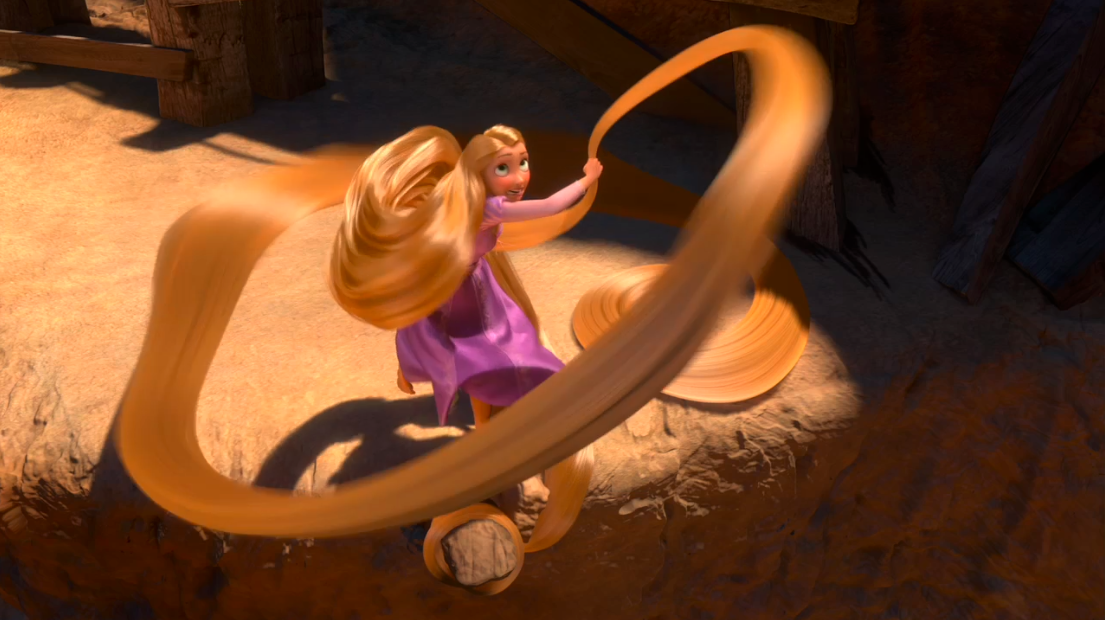
This movie has been hyped up as Disney's big return to form, especially after years of sub-par movies in the shadow of its partner studio, Pixar. I actually thought Princess and the Frog was the true return to form, but it turns out I was wrong (although I still enjoyed that movie very much). Tangled may be a return to form, but one that depends on nostalgia. Aside from the animation, the movie doesn't break any new ground or enter any new territory.

The story is pretty simple. Most of us know the Grimm's fairy tale of Rapunzel. The story revolves around a princess who is surrendered as an infant to a witch and locked in a tower, where the only known means of entrance is climbing the girl's supremely long hair up to the windows. The story here is altered a bit, with Rapunzel being a princess, and kidnapped rather than surrendered. Also of note is that Rapunzel's long hair has healing powers, due to her mother drinking an enchanted elixir while pregnant. The villain (kidnapper in this case) is Gothel, and she isn't a witch or an enchantress, but a very vain woman so consumed with being young forever. Gothel needs the power of the girl's hair in order to remain youthful looking. Move ahead 16 years later, and Rapunzel wants to see the world outside her tower, and gets her chance when a young hoodlum named Flynn Rider (originally a prince in the Grimm's tale) seeks solace in her tower while on the run.

The story, I have to say is not very original, but it is solid. There is enough development between the characters and their relationships. And while non of it is unique, it is enough to keep the story and the movie going along. Flynn Rider turns out to be a rather compelling character, one in which is so slippery that its hard to know whether or not to trust him. Although he's a thief, its only because he's something of a dreamer who thinks its possible to attain the impossible. This works in the relationship between him and Rapunzel: what she believes is impossible is actually possible, and its vice versa for him. Their relationship connects when they finally make these realizations.


Tangled is a mixture of two formulas: Disney's Princess films in the 1950's, and the modern Broadway formula in the early 1990's. They are updated further with Computer Animation. However, the CG is not the realistic "Illusion of reality" look Disney initially tried to achieve years ago, but a closer adaptation of Disney's original character designs from the previously mentioned eras. Glen Keane, who was originally one of the directors, contributes to the character designs of the film, and if you check out his blog and original drawings, the 3D characters bear a much closer resemblence to their drawn counterparts. A much appreciated breakthrough.

I have to say, when I first heard about this movie (when it was still called Rapunzel), I was curious about how they described the look of the film. Previous directors Glen Keane and Dean Wellins had stated they were working on a CG look that would capture the feel of 2D animation but with an emphasis on the look of oil paintings. I had no idea how to imagine this, but it sounded unique. What they finally have here is very nice, with a great job done on Rapunzel's hair (the much said struggles with the hair seem to have paid off). There were parts of the movie where I didn't like Rapunzel's hair, especially in the end when her hair gets cut off, and it looks all brown and pulpy (sound familiar?).


These formulas wouldn't be complete without the cute animal characters and broadway style songs which the characters break out into. Rapunzel's only friend in the tower is Pascal, a little chameleon that acts more like a cat than a lizard. The horse, Maximus, is one of my favorite characters in the movie. Maximus starts off as a loyal Royal Guard horse (acting more like a dog than a horse), fiercely tracking down the wanted Flynn, but then becoming a willing ally of Flynn, due to their mutual respect of Rapunzel. These misplaced animals personas managed to add to the enjoyment of the film.

I had problems with the songs. They just weren't memorable enough for me, even with Alan Menken, whose music many a child has grown up on. They just weren't catchy or lyrically poignant enough for me. "Part of Your World" from The Little Mermaid is still a great example of lyrical memorability. However, Menken has not worked with as bold a lyricist as the late Howard Ashman. I mean no disrespect to Glenn Slater, but these songs sounded more like they were playing it safe, rather than treading some new territories.

Overall, I come back to the same thing I tell everyone. The movie is good, but its not great. It may be a return to form for Disney, but its no great leap forward. I would have preferred something that broke new ground, either visually or story-wise. I give Tangled a 7 out of 10.

Tuesday, December 7, 2010

Harry Potter and the Deathly Hallows, Part I

I have written about the Harry Potter films on the domain before. Anyone who knows me knows I am a huge fan of the Potter movies. I have managed to read most of the original books by J.K. Rowling, but it was the movies that turned me into such a Potter geek. At least two years ago, it was announced that Harry Potter and the Deathly Hallows, the last novel in the series and the end of the story, would be split into two movies, Part 1 and Part 2. This excited me, as it was obvious that after a 10 year-long phenomenon, it needed to end on a grand scale.

Part I came out a couple of weeks ago, and I saw it on my birthday. Recently, I saw it a second time (as I missed about five minutes the first time due to an emergency bathroom break). And all I can say is fantastic. Its already got me revved up for the final part next July.

Although its a great movie, it has to be judged as part of a series. It will feel weird to judge it entirely as a stand-alone movie, which I notice some other critics have done. As a stand-alone movie, it is technically marvelous, but the script and story rely on everything that has occurred in the series so far. If the previous films are ignored, then the story is confusing and disjointed. Thankfully I know the story well enough to judge it properly. And on a technical level, the film is beautifully composed, with David Yates and his crew really taking their time with the story, and changing the tones a little more casually, as opposed to rushing them from scene to scene, as they did two movies ago on Harry Potter 5.

This movie is very unique to the series in several ways. For one thing, it is the first movie where nothing takes place at the Hogwarts school. Since Hogwarts has been the primary setting for most of the story, this movie allows us to see the main characters (Harry Potter, Ron Weasley, Hermione Granger) under completely new circumstances. Now they are travelling the U.K. completely incognito, searching for horcruxes, the secret to the evil Lord Voldemort's immortality. However, there appears to be something of a Holocaust occurring, with Voldemort's control of the Ministry of Magic cracking down on muggle-born witches and wizards (something akin to white Aryans frowning upon Jews and other minorities). In this Holocaust, the Ministry declares Harry Potter "Undesirable No. 1."


This is by far the darkest movie of the series, and the movies have been getting progressively darker as the characters get older. In this one, the main characters are completely cut off from their safety zones, and yet have to enter danger to find what they are looking for. And in the courses of this danger, characters get killed off. I tend to look forward to darkness in these sort of stories, as it helps to bring home the relationships between the main characters, and it exemplifies the themes a little quicker than if it were lighthearted. Even Rowling herself stated that the major theme of the story is "death."


There are some really beautiful landscapes throughout the main trio's travels. The outdoor settings really give the feeling of a road movie, with a wide open world surrounding the three main characters. I don't know who did scouting for this movie, but they deserve some recognition for finding these locations.


And there are more scenes in this movie that take place in the "muggle" world, or the world as we know it. There are more scenes that take place in the real settings of London and Surrey. I feel these scenes really tie the story close to home, and we can understand it a little easier, without putting too much logic on the setting.

A major highlight of the film is the animated "Deathly Hallows" fable. As a fairy tale that proves vital to the second half of the story, it is given a very special treatment. The story of the three brothers and their "gifts" from Death is told in a style rendered in CG, but reminiscent of the silhouettes of Lotte Reiniger's The Adventures of Prince Achmed (1937). The style is very engaging, and gives great clarity to what I consider to be a "difficult to remember" plot device. It was designed and directed by Ben Hibon with Framestore. Definitely worth the price of admission.


In terms of acting, which has always been a stand-out (at least for me) in these movies, those who get to shine really pull it all together. The three main actors (Daniel Radcliffe, Rupert Grint, Emma Watson) have practically grown up onscreen as actors, and the results really show. In particular, Emma Watson's performance of Hermione stands out. However, if I have one complaint, its that certain actors that don't appear for very long, they don't seem to put enough into their performance. In particular, this occurs with most of the Death Eater characters, sans Voldemort (Ralph Fiennes) and Bellatrix Lestrange (Helena Bonham Carter) who are terrific as usual. Other characters, such as the Malfoys (Jason Isaacs, Helen McCrory, Tom Felton), don't get the full treatment. In particular, I thought more should have been added to the character of Narcissa Malfoy, as she plays an important role in the upcoming Part II.

I would have also liked to have seen Bill Nighy's role as Rufus Scrimgeour expanded a bit (although that would have worked better with Harry Potter 6). However, in saying that, Bill Nighy is one of my favorite actors and seeing him as Rufus Scrimgeour is one of the highlights of the movie for me.

It looks like they wrapped up these movies just in the nick of time. The three main actors are starting to look too old to play the right ages of these characters. I'm sure everything will be wrapped up nicely in the last installment in July 2011. Its nice to have something to look forward to, isn't it?

Tuesday, November 30, 2010

Megamind...

DreamWorks's animated features have had the slowest time improving themselves (at least for my tastes). For all we know, this is as good as its going to get (and I hope I'm wrong). Five years ago, DreamWorks Animation was typified by dazzling computer animation and amazing effects, and voice-acting by the top-grossing actors of the day. While this is still the norm, they also relied on terribly transparent stories, rehashing pop-culture references and clichés (I still have a hard time appreciating the Shrek movies). In the last few years, their movies have improved slightly, with stories that, while not totally perfect, do not rely heavily on pop-cultural references or expose the actors behind the microphone.

Megamind is a good movie, but not a great movie. Its pretty forgettable and is likely to become dated as the years go by. But for the time being, it is a pretty enjoyable one. The story follows the evolution of the "bad guy" (another trend following Despicable Me??). In an obvious lift from Superman, Megamind (as an infant) is sent away from his doomed planet for survival on Earth. Unfortunately, the exact same thing occurs with a more human-looking child with super-powers. While the "human" baby is settled with a wealthy couple and lifelong public adoration, the blue alien lands in a Prison for the Criminally Gifted, and grows up with a twisted morale and is led to believe that he is destined to be super-villain. Flash forward to the present, Megamind is the arch nemesis of Metro Man, well known for their elaborate battles throughout Metro City ("Metrocity" as Megamind wrongly says it). When Megamind finally succeeds in killing his arch-nemesis, it seems like the clouds are finally parting for him. So what next?


The story has some socialist overtones to it, particularly in regards to public relations to large figures. If anything, there can be comparisons drawn between 2008 Presidential Election and the fictional reactions of the main characters. It seems like parallels can be drawn between Megamind and John McCain, while the same can be said for Metro Man and President Barack Obama. This isn't meant to be a political critique (I'm the last person to do that), but the point of it is that, with all the recent criticism of President Obama, it seems like he was rooted for the wrong reasons earlier.
In Megamind, the good guy gets to grow up in the lap of luxury, looking all perfect, while the bad guy grows up in a prison, with no proper role models. Megamind is brushed aside for his alien-appearance and loose morals, but turns out in the end to be just as human and good-natured as we see most heroes. Now Metro Man is loved all around (with a Jesus reference thrown in there), but his outward persona masks some sad flaws, as this "great" hero is just as human as any of us.
However, the story has a plot that could have gone in any direction, and the writers chose one of those alternate routes. It certainly helps that there's a sense of unpredictability to the story. I mean, what does the bad guy finally achieve when his sole ambition has been to kill the hero and take over a single city? For a movie built on clichés, it does a good job of mocking clichés.

One of my biggest problems with this movie is the design. The characters look generally boring, and I find their expressions to be limited. I have had this problem before, but I believe this movie could have benefitted from a little more stylization. The designers could have moved away from the mild DC look, which works better when drawn, not rigged in CGI. And the color design (which is a problem with nearly all Dreamworks films) still has that fast-food in the summer look to it. If the movie were better designed, the story probably could have benefitted from that.

There are too many destruction scenes with too much debris, but I guess that's to be expected is a superhero movie (I think I'm just very anal in that area). I still have that problem with big-budgeted movies: their shots and compositions are all over the place, and are too fast-paced.

One of the movie's hallmarks appears to be the use of popular music. Dreamworks always seems to be willing to pay handsomely for the biggest pop music hits, and that's no exception here. Megamind and his crew seem to have a preference for AC/DC and other hard rock gems. There's a very humorous scene in which Megamind's sidekick, Minion, keeps accidentally playing Minnie Riperton's "Lovin' You" when trying to turn off the AC/DC track. And there's a nice Michael Jackson tribute at the end, complete with the song "Bad." Is this all a good thing?

Don't get me wrong. I love hearing hard rock and heavy metal in an animated film. I just wish they didn't always go for the hit songs.

The voice acting is too flat for me. Will Ferrell is a good actor, but as a voice artist, it doesn't always work. His performance as Megamind is too friendly throughout, and at the beginning, it kind of gives away that the character is likely to change. The same can be said for Jonah Hill's performance, although it works to the story's advantage. As for the rest of the cast, there's still that sense that they are just talking into a microphone, and not putting a fully formed performance into the characters.

My opinion in the end? Like I said before, its a good movie, but I don't see it being timeless. This is a very expensive B movie. If I have to chart this on a scale of 1 to 10, I give it a 6.

Tuesday, August 17, 2010

Tales from Earthsea: We're not there yet...

Tales from Earthsea is sort of like a progressive rock album. On a technical level, it is quite extraordinary. The way the shots and action are arranged are top-notch. Unfortunately, it falls very, very short in terms of its content.

Mind you, I only compare this to progressive rock, because I've been listening to a lot of it lately.

The film starts off with a promising plot. But about 30 minutes in, it doesn't feel like much has changed since then. The beginning shows two dragons fighting in the sky, and this is witnessed by a ship crew below. It is established that seeing a dragon is normal, but to see them fighting viciously is very unusual. The two dragons are never explained again. We are meant to assume that this is a symbol of unbalance in Earthsea's environment.

The story moves very slowly. Its almost like a J.R.R. Tolkein story, fully of allegories surrounded by mythical and medieval occurences. But it takes a long time to reach the point of something, and you are never certain why you are reaching that point. Like Tolkein, it exists within a world of its own, with its own history and mythology. That much is explained, but it is never really explained how the main characters are connected to that.

The characters are never fully explained. My attention was mostly focused on the character of Arren, who is introduced murdering his father, and then running away, having periodic moments of suicidal tendency. This fascinated me, but wasn't touched upon later in the story. It seemed more like Arren was recovering from something, but we never find out what. Its possible his problems may be an allegory for bipolar disorder.

The character of Therru is kept a mystery throughout much of the story. We learn that she was an abused child, and her low social status makes her a severe outcast. But at the end of the movie, she is shown to be immortal, which is never fully explained. It seems like there wasn't enough time to fully round her out as a character.

The antagonist, Cob, is a very confusing character for me. On a simpler note, he's a wizard wishing to gain immortality, but the story alludes to a past he has, which is connected to Earthsea's mythology. The latter isn't explained very much.

Goro Miyazaki definitely has the technical prowess down. For a first time director, he helmed a nicely organized visual treat. But as a storyteller, he needs a ton of work there. And this seems to be the general consensus of the whole thing. Goro Miyazaki, the son of animation icon Hayao Miyazaki, needs to really concentrate on what he wants to say in a story, and how to fully explain that to the audience. It seems like he didn't spend very much adapting the screenplay (based on books by Ursula K. Le Guin), and more time structuring the technical challenges of the movie.

Something nice about Tales from Earthsea: it fits nicely with Studio Ghibli's other films. Its not the best thing they've done, but it doesn't ruin their track record.